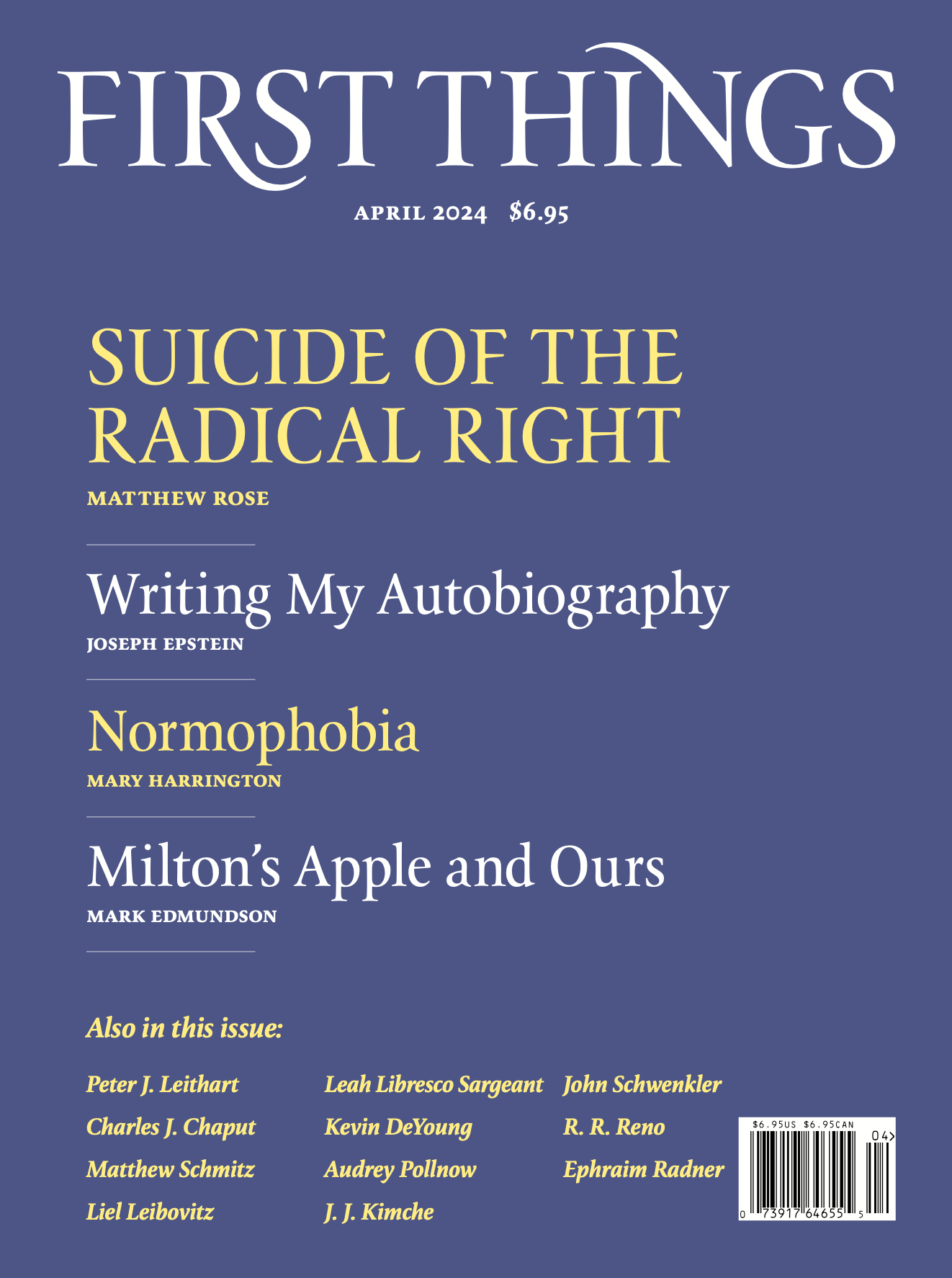
In the First Things print edition for April 2024, you get two (not heaping) helpings of John.
First up is a letter to the editor lamenting the Trumpification of FT as seen in the treatment of Russell Moore. At the back of the magazine is a review looking at the long road to Dobbs. (Has anyone else ever had two bylines inside but without his name on the cover? Does that make John a two bit player?)
The text of the letter is below:
Russell Moore has gone from prophet to punching bag in the eyes of First Things. Daniel Strand’s “War on the Culture War” (February 2024) makes that clear, and it is troubling.
In October 2016, R. R. Reno introduced Moore as “one of the most important voices speaking for faithful Christians in the public square.” In his Erasmus Lecture, “Can the Religious Right be Saved?,” Moore invoked this magazine’s founder:
During the scandals of the Clinton administration, Richard John Neuhaus warned us about the consequences of a national acceptance of a public loss of character. Neuhaus, a priest but no choirboy, knew that morally tainted politicians and leaders will always be with us, as they have been in the past. “The difference is that our intellectual leadership, the media and the then-mainline churches did not tell the morally slovenly sector of the electorate that they were right in their indifference to character.” Neuhaus knew that what was new was not the presence of sin but the loss of a sense of shame.
Apparently, Moore’s perspective has not changed in his latest book, but he is now labeled one of the “new crop of perpetual evangelical critics.” What Moore, channeling Neuhaus, sees as a shameful embrace of Donald Trump, is portrayed by Strand as a “reasonable transaction.” Strand notes the key upside, Dobbs, but waves away Moore’s concerns before concluding that “the recent evangelical reaction is a sign of spiritual health.”
Strand sees Moore as implying “that evangelicals didn’t choose the lesser of two evils; they chose evil.” I suspect Moore is concerned that many evangelicals no longer see their 2016 choice as involving any evil at all, as evidenced by new choices now being made. One could “stand for the natural family and against the toxic ideologies of our elites” without standing for the serial adulterer and chronic liar Trump. Isaiah rightly saw calling evil good and good evil as a source of woe, not a sign of health.
Moore is not beyond critique, but the responses to him doing what he has done for a decade can best be used as a mirror. In 2016 it merited a standing ovation. In 2024 it resulted in a sneering review. Moore closed in 2016 with a reminder that we are always “being overheard, in our statements and in our silences.” May the leaders of this important institution be able to look back on what is said and not said during the rest of 2024 and, with good reason, feel no shame.